


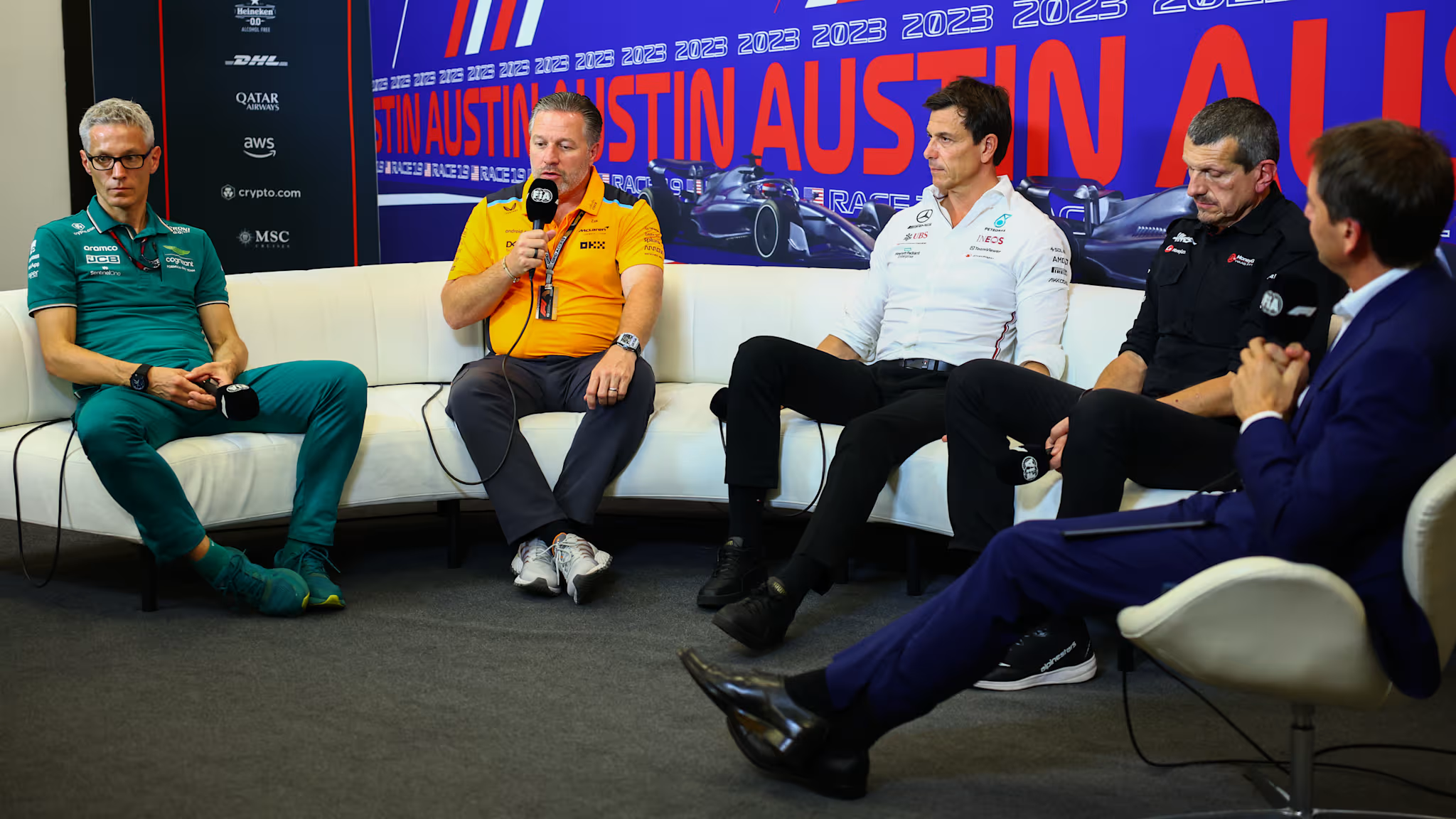
QUESTIONS FROM THE FLOOR
Q: (Adam Cooper – Motorsport.com) What lessons can the sport learn from the punishment that the drivers took at the last race? Is it time for the FIA to step in and regulate cockpit temperature, placing of electronic boxes and so on? And maybe Mike can talk a bit about how things were done in WEC?
MK: Yes, so I think the topic is the topic of the week or the topic of the current days. I think the GPDA and FIA are in exchange and we have to see what happens over the coming weeks. It is true that in other categories you have you have different devices. I think, Zak, you can also speak for IndyCars, where you have helmet cooling or any kind of active cooling, which we don’t have. So I think it’s something that over the next weeks we have to sit together with all the parties involved and come to a good conclusion. I think it’s in the interest of nobody to continue like this and the drivers need to be more comfortable if we want to have them extract everything and I think we should work together to achieve that.
ZB: Yeah, I think the teams and drivers will have a great ability to have different views on different topics but I think when it comes to safety everyone’s aligned and so you’ll get all the smart people in the room together to come up with a solution. I think everyone recognises that wasn’t a good situation, so we’ll get all the right people working together to figure out what’s the best solution and I’m very confident that’ll happen.
TW: Yeah, I would agree what has been said. That was, for me, the most extreme driver situation in terms of heat soak that I’ve seen so far. And I think there are some hardcore people that would say ‘well, that’s what the job brings’ and to a certain degree, that’s right. You need to be able to train for these extreme situations, but then maybe that one was maybe a step too much and it was unanimous from most of the drivers saying that we can’t do that. And if we can find a solution with the FIA and with the drivers to just cool the cockpit a bit more without drilling big holes into the cockpits, which would then again bring up a situation of what is it actually we need to change and how does it affect the technical regulation? I think this is not something we want to open up but in any case you need to respect the position of the driver and that wasn’t pleasant to look at.
GS: I agree with all that was said and I think to take the good thing out there, it’s not the plan, next year, to have Qatar at this period of time. So I don’t think.. The risk that we have a similar situation from the calendar is pretty low, at least. And now we know about it we cannot do it so I think we shouldn’t overreact to find technical solutions; Toto says to make big holes or big devices in the race car for a situation which came up once in 100 years here. So you know, I think we need to stay grounded and see is there a risk or not or can we avoid it by adjusting the calendar which I think is easiest way to do it.
Q: (Luke Smith – The Athletic) Zak, Austin’s very good proof of the growth that F1’s had in the United States, the record crowd we had here last year, the Drive to Survive effect. Is it going to be difficult for F1 to replicate that kind of shock, immediate growth in the United States being so – I guess upward and sharp in the coming years or is it more now about sustaining where we’ve got to in the US and ensure we’re not back to the bad old days of the boom and bust that we had in this country?
ZB: No, I think Formula 1 is going to continue to grow. There’s a lot of room for growth. We haven’t even had Las Vegas yet. That will obviously work great for the sport globally. And in North America, our TV ratings, we have a new television partner. There’s, of course, the Brad Pitt movie coming out next year which will be global but will no doubt have big impact here in North America. So I don’t see any reasons why the sport can’t just go from strength to strength and if you look at the size of our TV ratings compared to the major sports in North America, there’s a lot of room for growth. So I’m quite bullish on Formula 1 globally and specifically in North America.
Q: Zak, do you think the US could sustain four races?
ZB: I think the US could but I don’t think the Formula 1 calendar can or you wouldn’t want to add a fourth race to the detriment of another part of the world. I still would love to see us in India, in South Africa and another race in Asia etc so I don’t think we need a fourth race here. And that would, I think, compromise some other territory where Formula 1 can continue to grow. So I think if we look at Americas – Canada, Mexico, Brazil, here – I think we’re in great shape.
Q: (Matt Kew – Autosport) Gunther: Michael Andretti – and there’s obviously a big if around that entry – but he said he would have a preference for 2025 over 2026, so a year before a major rule change. Can you talk about your experience of that balancing act in 2016, between getting up to speed and also the trade-off of potentially writing off a car when it’s only a year old to put resources into a completely different sort of set of regulations?
GS: I think it’s very difficult to compare what we did. That was now 10 years ago, the regulations were completely different, not completely, but they were a lot different then and to compare it to now, the sport has got more and more complex as well. So I wouldn’t take a comparison and say it is easier now or it was easier then but it’s just completely different and I think it’s down to Michael to do what he wants to do and what he can do. I don’t know his plan so I don’t want to comment on that.
Q: (Jon Noble – Motorsport.com) Toto, I’m sure you’ve heard the phrase when the cat’s away, the mice will play. Your absence from the last two races coincided with your drivers getting their elbows out and these unpleasant situations. Do you think there’s a link between you not being there and that happening and has it changed perceptions of you missing races in the future?
TW: No, I don’t think.. we’ve laughed about that too in the team, but I don’t think it had an effect. I think we are racing more in the front now. I think we have a sniff, you know, how it is looking like to have no car in front of you with the McLarens and with Max there. In any case, we’ll never find out, I’m back.
Q: (Ian Parkes – New York Times) Zak, Tom asked you at the top of the session about Lando’s progression since 2019. He’s now in his fifth season. You’ve got a driver on the opposite side of the garage who has progressed considerably in the space of a few short months. Where would you see Oscar in about five years’ time from now?
ZB: Even more experienced. He’s extremely quick, he’s very mature, he’s very technical. He’s very calm: all the things that you’d like to see out of a rookie but you don’t necessarily always see out of a rookie. Clearly his pace is fantastic and I suspect his race craft and his tyre management and his race management will only get stronger and stronger as he gets experience. I think people forget, he also sat out last year so he didn’t have much rust on him when it comes to race craft but I think he’s definitely showing every signs of being a potential future world champion.
Q: Has he surprised you in any way?
ZB: Yeah. I think the maturity and the way he approaches a race weekend, he kinda doesn’t worry about Friday, which I think rookie drivers maybe sometimes want to win free practice one and they end up in the fence, and then they never recover from the weekend. So I think the part that’s impressed us most is his maturity. He’s not driving like a rookie, we knew his pace was going to be there and he’s very technical so he studies, learns and puts it together when he needs to.
Q: (Alex Kalinauckas – Autosport) The same question to Toto and Mike, please. In a couple of weeks F1 is arriving in Las Vegas for a very eagerly anticipated race. I just wondered, could you please talk us through you and your team’s preparations for that event? And also, given it’s a new race in that city – a famously lively city – are you having to put any special measures in place? Are you banning any team staff from the casinos or the music or anything like that?
TW: (To Mike Krack) You want me to get it wrong first? I think it’s very exciting to go there. It’s a Mount Everest to climb, I think, for Liberty and organising that you’ve got to take your hat off, not only doing it first time, but also in a city that is complex to navigate, I guess. But we’re looking forward to it. It’s going to be midnight race. We don’t know what the temperature is going to bring. But in any case, it will be entertaining. And from a marketing side, we’re just blowing everything out of the park that we’ve previously done. We have a big building that we call Las Vegas club where we’re going to host over multiple levels, hopefully Las Vegas-worthy entertainment for our guests. And very much looking forward to it. We don’t know how we’re going to travel from A to B, from hotel to the track, but I’m sure we’ll we’re going to find solutions there. But I’m very excited. I’ve never been to Vegas. So we’re going to keep everybody out of the casinos. I don’t play. So I’m going to make sure that nobody plays!
MK: Yeah, likewise. We are quite excited about what’s going on there. I think the efforts that are being put in are just incredible. When you see the infrastructure that has been put in place or is still being put in place, plus Las Vegas itself. There will be a lot of distractions. It is important to focus when it is the right moment. And then the track. I think the track has been designed maybe also to promote overtaking, to promote a good show. But I think all in all, Zak said it initially about Las Vegas, I think it’s great that we go there. And I think Formula 1 will just grow from it. And yeah, from the point of view, I think nobody will not like to go. I share Toto’s concern about how we get there!
Q: (Graham Harris – Motorsport Monday) A question for all. Zak mentioned future Grands Prix in South Africa and many, many other countries are clamouring for races. We are at 24 races next year, with the potential of going to 25 according to the Concorde Agreement, but is 25 really practical? And have you thought about possibly alternating races between some of the circuits – one year, one circuit, one year the next?
GS: I start with the alternating. I think that’s a question for FOM to decide if they alternate. What the contracts are doing, we’re not involved in that one. I think it would be a good idea. In the end, I think it could work that you get more countries on the calendar and expose our sport in more countries. Going to 25 races? In the moment, there is no real talk yet. I mean, it’s in the contract agreement, or what you say, I haven’t seen it. But in the end, if they put it in there, for sure we will be asked. I think 24, for the time being, is a little bit the limit, of quantity. But if we go more, we will need to find other solution. It’s also, how are they staged? If you stay in certain regions for a while, you know, there is less travel involved, back and forth, long haul flights. So there are a lot of things to be discussed. But there is in the moment, I think, next year we know it’s 24 races, we’re going to deal with that one, we’ve never had 24. And then we see what’s coming out. But in the short term, I think 24 is the number we need to manage.
TW: Yeah, I think like Guenther said, I agree. Twenty-four is already is already a lot. I guess if we can another good venue that is accretive to the calendar, for sure, we’ll find a way of accommodating it. We, as a team, we’ve already started to run shifts. Many people don’t do all races anymore. But obviously you have the race engineers that are dedicated to a car and the drivers that you can’t really swap a lot. So whether it is 24 or 25, it wouldn’t make a big difference. But we’ve got to accommodate them on the continents, like Guenther said. Sustainability is a key topic. And I think FOM that is deciding about those things is doing a good job in evaluating.
ZB: I think 24 races is the max for people’s wellbeing. But we need to continue to expand the sport. So I’d like to see a scenario where you maybe have 20 fixed Grands Prix and, say, eight that rotate every other year. So you have a 24-race calendar, but you expand the sport by going into other regions and other countries. That being said, I don’t know the economics inside out of how it works as a track promoter. So whether an alternating calendar is economically viable for the promoter, but I think that would be the ideal scenario. But, easy for me to scratch that out, more difficult for Formula 1 to put that scenario together. But I think that would be most ideal.
MK: Yeah, I think I do not want to repeat what has been said. I think what is important is that we keep in mind that this is a World Championship, and we’re still missing one continent, while we go a lot in others. So I think there is still a little bit of work to be done. But all in all, I think F1 does a great job there, we have seen it over recent years. Now the number, if it’s 22, 23, 24, I think we will always find solutions to handle that. But all in all, as I said, World Championship means for me racing on all continents.
Q: (Mark Cipollone – Autoracing1.com) Team owners have been pushing back on this idea of Andretti coming into the series. This past week, Mohammed Ben Sulayem has pretty much said that Cadillac is going to come in as an OEM. Now, they haven’t officially announced that, but his words were, that’s what it sounded like. If Cadillac is coming in as an OEM, what more does Andretti have to do to get accepted by you guys?
MK: Well, it’s not about ‘accepting by us guys’, we have no say. The topic is with F1. I think, if I’m right, participation has been granted by the FIA. And, you know, there is nothing for us to say, nothing for us to decide. The topic is with F1.
ZB: Yeah, it is. It’s an F1/FIA decision. The FIA has put forward their view. And while the teams all have a voice, we don’t have a say. And also, I don’t think we have a lot of visibility to the teams that weren’t accepted and the teams that have been accepted. And so therefore, I think until we know more, I think it’s hard to say there should be more of this or less of that, because we really don’t have any visibility to what’s gone into the decision-making process.
TW: I would follow what these two gentlemen said.
GS: And I would agree with these three gentlemen!
Q: (Edd Straw – The Race) The FIA has raised the ceiling for fines for competitors in Formula 1 up to 1 million. Are you all happy with that? Any concerns that could lead to a dramatic increase in the level of fines and has the FIA made all of this clear, their reasoning for doing that?
GS: I’m worried, because I don’t want to be the first one to get into that area. I guess I need to be careful what I say now, because normally it’s getting me here, from these four gentlemen. No, I think for me it was very unexpected how it came along. Is it needed? I mean, 250,000, I think it’s Euros, it’s quite a lot of money in my world, you know. There are people, drivers, which make a lot of money out there, and all that. And but obviously, it’s earned, it’s not given for free. So, if you do something you shouldn’t be doing, there is a limit to what you should fine somebody. It needs to be realistic. And also, I think a few drivers brought it up: where’s the money going? In a lot of sports, it goes to charities, which if I would have a say in it, a vote in it, that’s what I would say. I would suggest, you know, if somebody has to pay these high fines, at least he should be involved in saying where it is going – to a charity which he likes or something like this. So, I mean, I don’t really understand why we need this high level of fines. I mean, the best is try to stay out of it or not get one.
TW: Yeah, I think that there needs to be some deterrent for grave infringements of the regulations. But none of that was on the radar of anyone, that it would be coming. I think a million, we need to do a reality check with real life, whether that is an adequate fine or not. I don’t think we’ve ever fined a driver 250. So raising the ceiling is something that one needs to understand where it comes from. And I don’t think we want to portray Formula 1 out there in a world where it’s tough enough to give drivers fines of a million, I think half of the grid wouldn’t be able to pay them. And I don’t think it’s adequate considering… I don’t think we should be playing around with those numbers that seem very surreal for people that are watching us.
ZB: I don’t intend to get a fine, so I’m not going to worry about it too much. Knock on wood. I’ll probably get one now. I think it’s not really been explained, at least to the team bosses. I would imagine to get a fine of that size, you’re going to have to do something pretty grave. So I would hope that no one on the grid will ever see anything near that level. So hopefully, all will just be business as usual.
MK: Yeah, I agree. Especially, I agree with what Toto said. Let’s keep our feet on the ground in throwing around such numbers. We have spectators here that are buying tickets already for quite high prices. And by throwing numbers around like we do currently, I think we need to come back a little bit more to reality. As you said, there is a lot of drivers who are not even making anything in this area. I don’t know where it came from. I was caught out this way when I read it. And yeah, the most important is that you’re not getting caught.
Q: Grassroots motor sport development is where those fines go.
Q: (Jenna Fryer – Associated Press) More on Andretti, sorry. I spoke with him this morning and one of the things he said was that his support from Mohammed and FIA is so good that he really has started to feel that the pushback is personal. And I know you guys have no say in it, but he said that that at least half of the team’s, it is personal and they’ve made it political with FOM. Does anyone have a personal grudge against Michael Andretti?
TW: I don’t know him! I don’t know him. I think that his father has a fantastic track record. I mean, he’s one of the great names of the sport. I think Andretti, as a racing team, has been doing well in the United States. For sure it’s that and they’ve won the Formula E Championship. But there’s no grudge. If you haven’t really met someone, you can’t have a personal grudge.
GS: No, nothing personal. I think I know Michael but not very well, obviously. I mean, I met him a few times, but nothing personal.
ZB: I think everybody knows I’m good buddies with Michael. So I’ve got no grudge. I’m partners with him!
MK: Same for me. I’m not one of the five. I worked with Michael in Formula E in my previous life, and I can only say good things about Michael and his team.