


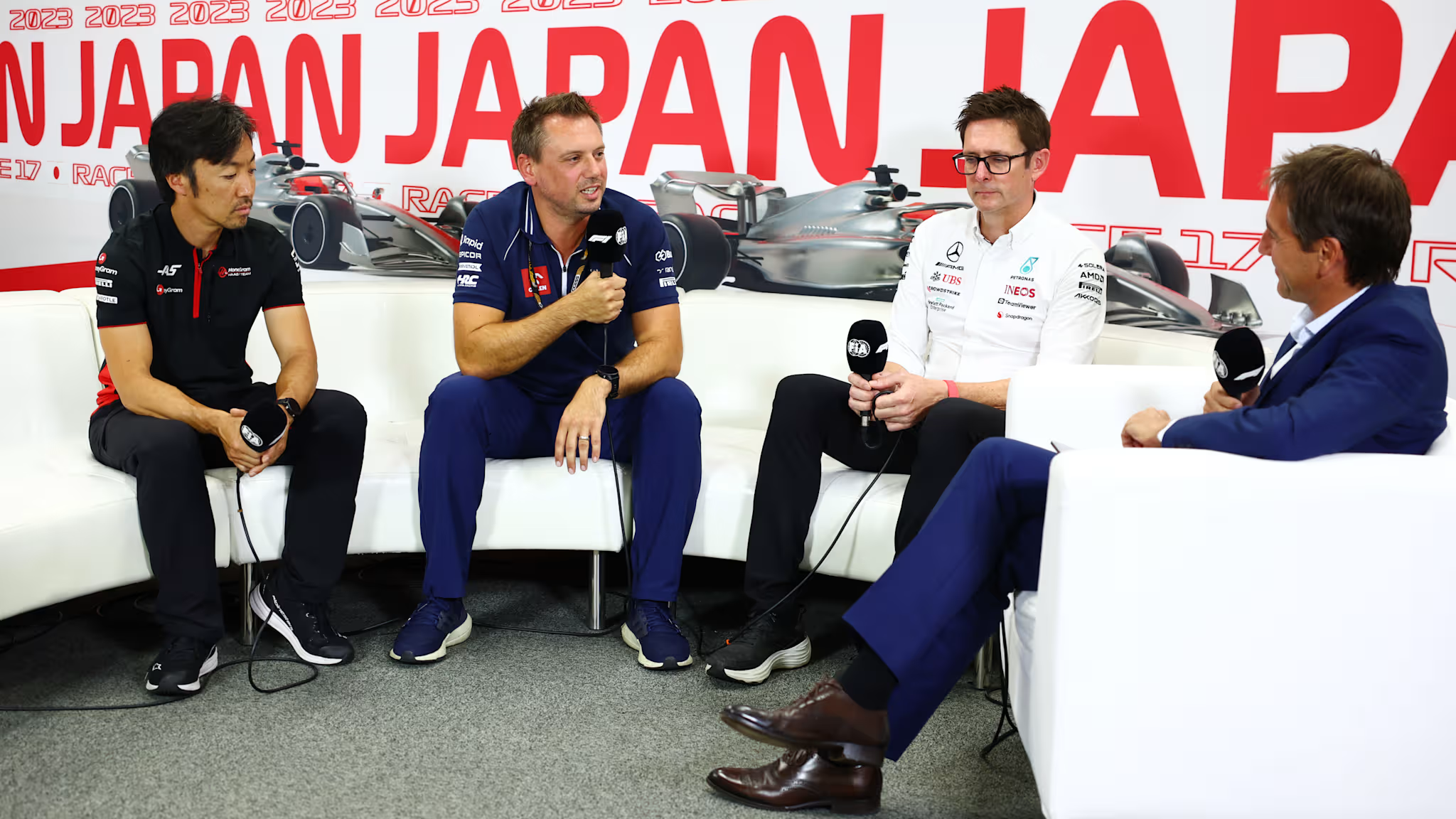
PART 1 – TEAM REPRESENTATIVES
Ayao KOMATSU (Haas), Andrew SHOVLIN (Mercedes), Jonathan EDDOLLS (Alpha Tauri)
Q: Ayao, I feel we should definitely start with you. In engineering terms, local hero, home race for you. We saw you signing autographs yesterday. Just tell us how different is this race for you?
Ayao KOMATSU: It is very different, because those Japanese fans are amazing. I think last year, with COVID, they still couldn’t do the pit-lane walk – but this year they could, and it’s so good to see the kids. They always have primary school kids preparing gifts for every team. It’s amazing, I think the atmosphere is great. It’s good!
Q: And what about your memories of Suzuka. How long have you been coming here. Not just in a work capacity, did you come as a kid to watch the race?
AK: No, I’m from Tokyo and I never actually came to watch a Formula 1 race before – but watching it on TV, in the Senna vs Prost era, so I’ve got memories of the Chicane crash and the Turn 1 crash. So that’s how I got into it. That’s the first memory I have.
Q: That’s what made you want to come into Formula 1? The crash between Senna and Prost?
AK: Basically, yeah!
Q: Let’s talk about performance. Throw it back to Singapore, first of all. How pleasantly surprised were you by the pace of the car there? Both guys getting into Q3 and Kevin getting that P10.
AK: I think understanding our car’s weakness and strengths, Singapore we expected to be more competitive but my hope before coming to Singapore was to get at least one car into Q3. I thought if we did a really good job we could get both cars into Q3 but Kevin’s P6, we definitely weren’t expecting that, so it was better than expected.
Q: Kevin has two fastest laps in Singapore, he got the P10 of course in the race on Sunday. Why does he go so well around Marina Bay?
AK: I think a couple of reasons. His driving style is very strong on braking and entry and on some of the other circuits where the car is experiencing some combined entry, he struggles with that more, whereas in Singapore, that kind of circuit, his strength on the corner entry pays quite a lot, because the cornering phase is quite short, so he’s always been strong there.
Q: What about Suzuka this weekend then? First of all, how is the return to harder tyre compounds affecting the car?
AK: I don’t think the return to the harder compounds itself affects the car. It’s actually more the type of corners we have here. So, that’s where possibly the weakness of the VF-23 might get exposed. Corners like T11, 13-14, those corners. That’s where we really need to manage. So, it’s not the tyres, it’s more of the cornering characteristics.
Q: Tell us a little bit more about this year’s car. Why has it proved so difficult to tame?
AK: You mean tame as in race performance? When you’ve got brand new tyres, extra grip, you can mask lots of weakness of the car, whereas when you do a long run in a race stint, those little weaknesses you can mask in qualifying, those get completely exposed – and it’s cumulative. So the characteristic you can survive for one lap or three laps, or five laps becomes very apparent, and that’s the weakness. Why is it difficult? Because I think the concept of the car we’ve got, we’ve been trying to develop it, trying to make it better but we haven’t been really finding the solution. So yeah, that’s why it’s been quite difficult.
Q: So, how much hope do you have for the upgrade that you’re bringing to Austin in a couple of races’ time?
AK: Austin, it’s a huge push from the factory to get there. It’s quite a bi update package, but in terms of putting on outright pace, it’s not that really, if you like. It’s more we’re doing it, and it’s a different concept, so we learn as much as possible as well, so to do that learning in this year ahead of launching next year’s car is quite big. So, I cannot say for certain in terms of out-right quali performance or race pace performance that we’re going to go X-amount quicker but, in terms of learning, and having different characteristics of the car, I think we have done quite a lot. So, it is very important that we do this.
Q: How extensive are the changes going to be on the car? Can we refer to it as a B-spec car? Is it that different?
AK: I think, officially, we’re not really expressing it as a B-Spec car. It’s a bodywork change, sidepod inlet, floor, so it’s pretty extensive. We’re not doing front wing or rear wing but the aero characteristics are very different to what we’ve got here.
Q: Jeddolls, let’s come to you now. You’ve got the local hero in one of your cars. Just how different is this race for Yuki, and the team?
Jonathan EDDOLLS: It’s very special for him and that comes off onto us as well. Just coming in, in the morning, in the van, the queues of the fans – I’m sure you had the same – cheering and waving and it’s fantastic – and that’s just the entrance, coming in. And then the fans in the grandstands. Yesterday, we had so many people in the pit lane giving gifts to everyone. Fairly random gifts and quite a range of different ones – but it gives the whole team a boost, and particularly Yuki off the back of a couple of difficult races. To come here, home race, and to have that as a start to the weekend has been a good boost.
Q: As you say it has been a couple of difficult races for Yuki. He hasn’t done a lap at either Monza or Singapore. How much frustration is coming in do you feel?
JE: I mean, he’s frustrated at the time, for sure. But he’s very good at putting that behind him. So, the frustration from Monza he was able to put behind him and really focus on Singapore. And I think we saw in Qualifying, the performance was there. We couldn’t quite get it together in Q2 for him. And then again, some frustration in the race with the collision. But again, coming here, we just tackle each event step-by-step. So that frustration has been put behind and we focus now on trying to extract the maximum from the package this weekend.
Q: Well, there were upgrades in Singapore. FP1 looks like you’ve hit the ground running here. What can you tell us about the performance?
JE: Yeah, I mean, obviously, Singapore, we had quite a big update. Everything looked to be working as expected there, the performance was there. Singapore is one of those special circuits where it’s quite hard, particularly on the aero side, to validate 100 per cent the package and everything is as expected. So, coming here, it’s a much easier track to understand if everything’s working. So far, the data analysis live was all as expected and I think the performance has shown it looks like we are taking a bit of a step forwards. Yeah, it’s only FP1 and with many different run plans, and we’ve got the extra tyres here, some were using them at different times, but I think the signs are positive.
Q: Let’s talk about Liam Lawson. Now, what has impressed you about him in the three races he’s done?
JE: I think probably how level-headed he is. How solid he’s been and how he’s not let the pressure get to him – because it’s obviously a big jump for him. I think, stepping in on the Friday night in Netherlands, when it was forecast rain, the next day, was a bit of a shock to him. But he quickly got over that, got up to speed with the car, the tyres, difficult race, difficult conditions. But I think the thing that’s most impressed me is how solid he is. In qualifying, he’s just chipping away, building it up step-by-step. We focus on like a weekend plan, aiming for that lap in qualifying. And I think Singapore, another difficult track, he’d not been there before, we used the three sets in Q1, just to ensure that he got there. And then he did a solid Q2. And I think the other point in the race he was keeping some fast cars at bay. And you felt confident that he could do that for a while. So yeah, I think the whole team has been very impressed with him.
Q: You say he’s solid, what is his feedback like?
JE: So, the feedback is very, very good in terms of the car and what he needs. Obviously, Formula 1 racing is new, so during the race, the information still is flowing more towards him than it is to us, as expected. But I think in terms of his feedback of the general characteristics of the car, how the tyres are behaving, it’s very good.
Q: And what can you tell us about Daniel Ricciardo’s recovery, recuperation? When are you expecting him back?
JE: Well, we all saw him in Singapore. He’s still going through that recovery phase. I’d say we’re still talking a while away. So, I wouldn’t want to put a target on it. The recovery is going well. We’ve got some simulator work planned before a return. And I think from our side and his side, there’s no rush to get him back too early. The worst thing would be to come back before it’s properly healed and cause any issues. So yeah, watch this space.
Q: And Jonathan, you’ve got a really nice problem. You’ve got three really capable drivers, but only two seats for next year.
JE: Yeah, it makes it a tough one. Yeah. Well, I think nothing is official yet on what’s going to happen for next year. But I think probably there’ll be an announcement at some stage.
Q: Shov, coming to you now. Thank you for waiting. Let’s throw it back to Sunday, first of all, a very disappointing ending to that race for George, how can you and the team help him move on?
Andrew SHOVLIN: Well, I mean, he was obviously very upset himself about that. He was more gutted than anyone. And the team has been really good at just sort-of working with him, giving him a day to just go off and clear his head. But he’s come back here very much business-as-usual. But you know, the team will make mistakes from time to time, the drivers do. I don’t think he’ll do that one again. And as much as it was unfortunate to lose some points there, he put himself in a position where he could challenge for the win. And it was nice to see that. And that was actually a great feeling for the team, even if it didn’t last as long as we’d have liked. But those laps where you really felt like you were fighting for a win again.
Q: And in terms of car performance in Singapore, is it fair to say that you had the fastest car on Sunday?
AS: It’s difficult, because so much of the race, everyone was held up, there were different tyre strategies. I think we had a car that was close enough to fight for a win. And you know, that’s what you can be confident of. I think if it hadn’t been for Norris being able to catch that DRS, then we probably would have done it. And it was nice to see the strategy team, as well, taking some bold choices in terms of the strategy. But where we fell, relative to McLaren to Ferrari, that all felt pretty normal to be honest. The big difference was Red Bull weren’t there, and normally they are. If you look at FP1 today, you’d say they’re back to where they should be.
Q: Can I ask you briefly about Red Bull in Singapore, in that you’ve been there as well, at the Marina Bay circuit, back in 2015. You were dominating the season, but that was an outlier that weekend. What is it about that racetrack that makes it so difficult and so unpredictable?
AS: The problem that we had was actually quite specific to the old set of regulations and how the car was working aerodynamically. It’s very bad for overheating, it’s a street track, it’s quite bumpy. If the drivers haven’t got confidence, that will always rob quite a lot of lap time off them. And in particular, it’s really hard to keep your rear tyres under control because of all those traction zones. So, it’s quite a nuanced circuit. But you know, we’ve had one really, really difficult year there, it was very good for learning and probably you’d say Red Bull will find the same: that they’ll get to the bottom of what went wrong, and it won’t be a mistake that’ll happen again.
Q: Now, Lewis has said that this year’s car is one of the hardest he’s ever driven to get into the right working window, do you fully understand it now?
AS: Well, I mean, we were doing a lot of work to try and solve some of the problems on this car, make sure that we don’t have them next year. We have moved it forward, the car we had previously, in 2022, that tended to be an awfully long way off in qualifying, it was generally racing a bit better. The performance was very, very track specific. So, some areas we have improved. The big issues, we’re just not quick enough. So, we need to find a good chunk of performance, to challenge Red Bull in particular. But the other thing is the field is now super close. So, you look at some of the gaps we had 12 months ago, and you can have a decent qualifying position, you might be fourth or fifth on the grid but you were eight, nine tenths off. Now, if you do that, you end up getting bumped in Q1 or Q2. So there’s lots for us to work on and certainly some of the work will be about making sure we can give the drivers the confidence in the car that they’re lacking at the moment. And that’s a big area. We’ve got some interesting projects that hopefully they’ll come off.
Q: Shov, looking at this weekend, you’ve said it looks like Red Bull are back. But how is your pace relative to Ferrari, relative to McLaren?
AS: Well, on the basis of FP1, we’re glad it’s not a sprint race, because we’ve got a bit of work to do! But you know, we haven’t changed the car coming here. The circuit’s unique, but it’s not a total outlier. It’s not like Monaco or somewhere. So, logic tells you we can probably chip away at it, try and get it in a better window. We just haven’t landed with a great balance here. And it’s also a little bit confusing hopping around with a new tyre compound. But fundamentally, a bit of work to do on the set-up, we probably get that, half the tracks. We land at, we’re having to adapt the car to get it to work. And again, that ties in with what Lewis was saying. It’s not an easy car to just land on track, and it does everything you want it to: you do need to do a lot of fine-tuning. But our record for doing that has been pretty decent over the year. So, we’ll do the work we normally do. We’ve got the simulator team back in Brackley and they’ll be getting that ready to roll and hopefully we’ll make some progress for the next session.
QUESTIONS FROM THE FLOOR
Q: (Luke Smith – The Athletic) Andrew, a question for you about George. Obviously, he’s worked with Mercedes for a very long time, now. What are some of your earliest memories and impressions of George when he first joined the team as a young driver? And have you seen those characteristics grow to now being a grand prix winner for the team?
AS: Well, I think when we first ran him in an F1 car, that was one of the post-season Abu Dhabi tests. And obviously, whatever you come from, it’s a big jump. He’d come from F3 into that, and just in terms of throttle control, ability to look after the tyres, understanding what’s important, consistency, the approach to starting and then just chipping away at it without, you know, taking risks without making mistakes, you can normally see the good ones pretty early on. So, there was no doubt there. But, for us, the bit where you realised he was pretty impressive was when we jumped him in when Lewis had COVID. Great job, a lot to take on, very little time to adapt to the team, the car. And you know, he’s continuing to improve and get stronger.
Q: (Jon Noble – Motorsport.com) To all three of you, over the past two years of this rules era, when the word concept has emerged, it’s always been linked with the sidepods and there being this tenuous link between the two. But from your perspective, when you talk about concept, what’s your view of what a car concept is? And what are the initial considerations you have when you’re talking about what you want a car to be?
AS: Well, for us, we view it in a bit more complicated way than just what do the sidepods look like. And what the sidepods look like interacts very heavily with what’s going on with the floor. And the floor is the thing that’s generating most of the downforce. So, you know, you use the word like we’re going down a different (path), or exploring a different concept, but, generally, that, for the teams, will mean that there are changes right underneath the car and it’s about putting the bits together above that are going to be conditioning the flow. So that’s one element. But then the other thing, with a new set of regulations, is working out where you want to target the downforce. Where are you wanting to chase in terms of efficiency or drag levels? And a lot of the work we do when we’re talking about going off on a different development route, is actually saying, where do we think the real value is? And when your resources are so limited, you need to be very careful about where you’re searching for performance, because it’s got to be fruitful, because you’ve got so little tunnel time, the cost cap is making things difficult… You don’t want to be exploring in barren lands, basically.
JE: I think you summed it up pretty well. Clearly from our side, when we come to the track with a different concept, there’s generally a lot of learning to do to understand if, particularly on the aero side, if it’s behaving as expected. Some change in concept require a different set-up, different heave stiffness platforms, different mechanical balance, weight distribution to optimise the aerodynamics, and how you can get the tyres working. So yeah, the first thing then we do at the track is the correlation work to validate all of our pre-event and simulator work, and then take that feed that back into the models and see how to adapt the set-up to extract the most from that change in concept.
AK: Yeah, I think mostly covered, but then maybe on extra dimension I’d add is just the consistency or robustness of the car, which is what we need, which is what is lacking a little bit on the car. So that’s what we’re trying to improve.
Q: (Scott Mitchell-Malm – The Race) A question to Andrew, just to talk about Lewis in a bit more detail with this car. He has talked about having ups and downs in qualifying. Before the summer break he was on that really good run relative to George – I think it was six in seven that he qualified him. Since the summer break, he’s sounded a bit unhappy. Is that just part of how difficult the car is to get in a sweet spot? Or is there something specific Lewis struggles with? And why does he turn around so effectively on Sundays, because his points haul and podium rate this season has been very impressive.
AS: Well, he yeah, as you say, he’s always performed on a Sunday. And that’s been brilliant, because he’s always been able to bring home decent points for us. The car is a bit fiddly at times. If you don’t get it right in the window, you can end up struggling through the session. The other thing that makes it difficult is that it is so hard to get through Q1, Q2 these days. And you know, a few years ago, we would just do one lap, middle of the session, it would put you completely safe. Sometimes we’d go through two sessions on one set of tires. And if you don’t get the right balance, if you get a bit of traffic, if you can’t do the right out lap, all of those things really cost you. So it’s a combination of things. But you know, the race pace has been good. It says that the car is broadly where you need it to be, but understanding the tyres when you’re under pressure, when you’ve got to make sure that you do get the lap in the first session, it is difficult and that certainly makes it a challenge for any driver who’s not completely comfortable when they roll out in Q1.
Q: (Joel Tansey – The Japan Times) This question is for Jonathan. I’m wondering what you make of Yuki’s season so far and what potential you see in him going forward?
JE: Yeah, I mean, obviously, the season has been a challenge for us as a team. We haven’t had a package that we have had in previous years or a package that we expected to have. So it has been a challenge at each event even to score points. But I think Yuki, he’s taken a quite a big step up this season. He came in obviously with a rookie teammate, so in a way he was our most experienced Formula 1 driver. And he took that on his shoulders and performed well. I think he’s definitely maturing and we all know in his first year or so he was quite hot-headed in the cockpit, on the radio. He’s controlling all of that now and I think focusing that on understanding the car, and focusing that on the driving. So I think we’re seeing a much more consistent Yuki this year. And, you know, he’s shown as well, that he is very, very fast, capable. The lap in Singapore was a great example. And also he’s had some strong races. As I said, we just need to focus on improving the car to give him a package that he can consistently fight for points with.
Q: You say he’s taken a step up this year, in what areas? Is it just consistency or is there…
JE: I think, you know, the whole approach to the weekend. The consistency, he’s focusing on understanding the car, giving better feedback. He’s maturing as a driver and that’s helping us focus on the areas to help him go faster. I think he’s also understanding more what he needs from the car, in terms of… You were talking before about the balance characteristics, the entry stability, all these sorts of things. Before, he was still learning. And he went through the change of regulations. And us as a team, as well, we know how to extract the most from him based on the data, his feedback. So I think, you know, we’re gelling as a group. And that’s showing in his performance.
Q: (Matt Coch – Speedcafé.com) Jonathan, you mentioned that Daniel is going to jump in the simulator before he makes a racing return. Is it fair to describe that as a fitness test? And if so, what are the sorts of things that you’re going to be looking for from Daniel, I guess, in terms of your freedom of movement in his hand, grip strength, those sorts of things?
JE: Yes, it’s really that. So he’ll jump in the simulator, you know, it’s a very good representation of the car, all of the loads, etc. I think the final decision is more than likely going to come from him rather than from us. He will know better than anyone how’s the pain, how’s the recovery. So, as said, we’re not putting him under pressure to come back. We’ve got a pool of three good drivers at the moment. And yes, there’s no big rush. The focus is on him making a full recovery so that when he comes back, it’s not a point that’s even talked about.
Q: (Flilip Cleeren – Motorsport.com) Jonathan, you mentioned the luxury problem you have on the driver side. Has this recent streak of races given you a good idea of what Liam’s potential is, given that he hasn’t had the preparation or the mileage? He says there are still a few tenths in the car that will come later on, whenever he does return to your car. What do you think his potential is? How far can he go?
JE: Yeah, I mean, from what we’ve seen so far, you know, he’s got in and he’s got up to speed very, very quickly. You know, Yuki has still, just, got the edge on him, which is totally to be expected with the experience. But I think the fact that he’s gone in, he’s been able to qualify well, he’s got into Q3, score points very early in a car that’s not the most competitive and at times is difficult to drive. You know, I think, from what we see, compared to some of our previous drivers, definitely he’s up there. And he’s got the potential, so I think we’re all excited for more races working with him, in the meantime, while we wait for Daniel to recover.
Q: (Adam Cooper – Motorsports.com) For all three of you. I know it’s still a few weeks away, but I can ask for your thoughts on Las Vegas, what kind of track it is from the early sims you’ve done, what kind of challenges it presents, especially with regard to tyre temperature, because people are saying it might be five degrees towards the end of the race?
AK: Yeah, I think it’ll be a big challenge for us, especially our team, with the tools we’ve got in terms of a pre-event simulation, more limited, let’s say, than Mercedes, so we’re going to have a big challenge on our hands. But yeah, still a very different temperature window. So we’ve got to get the tyres to work, but if I had to choose hot or cold, I would choose cold conditions at the minute. So hopefully you can get it to work and it’s a challenge we’re looking forward to.
JE: I think, so far, from the work that we’ve done, it’s got many long straights, quite a few low-speed corners, not so much high-speed content so maybe a track similar to Baku, that sort of layout. The temperatures are going to be probably one of the biggest challenges. I think we’re expecting circuit 10 degrees of ambient, so very much like the winter test. But then, you know, in many years, we’ve done winter tests in Barcelona at those sorts of temperatures. So it’s not going to be completely new to us. But definitely, it’s quite a step away in terms of where we’re going to be operating the car and tyres to what we’re used to in a normal season.
AS: Yeah, I think it’ll just depend on exactly how cold it is. Because if the track is down in single figures, that’s often a region where you go winter testing, you do a run, it’s very difficult for the tyres to either get them switched on, or there may be graining and things. And then sometimes you just wait until it warms up a bit. So actually going to have to sort of race and qualify in those conditions, it will be interesting, but you just try and identify the risks with the new circuit, work out what your contingencies will be, whether you need any sort of specific car spec to deal with that, and we’re going through those at the moment. But as I said, if it’s at the very cold end of predictions, it’s difficult to know how they are going to work.
Q: (Luke Smith – The Athletic) Jonathan, another question for you about Daniel and his impact on the team. Obviously he came with a lot of experience, which is very different to a lot of the drivers that AlphaTauri typically goes for, young drivers. Could you really tell that experience shining through in terms of his feedback and helping you point the car in a better direction?
JE: Yeah, I mean, pretty much straight away, you could feel the quality of the feedback, not only the feedback on the handling of the car. Obviously, he’s got a wealth of experience and he’s driven many different cars and experienced many different ends of the performance spectrum. So having that feedback on our car was extremely valuable for us. But also, I think the other things that were impressive, and reminders of what experience can bring, were: how he could understand the race; the feedback that he could give live; how he thought the tyres were behaving – was it a one-stop or a two-stop; or if there was a Safety car, could he reheat these tyres? Or would we need to fit a fresh set? So a lot of the time, we’re making those decisions from the pit wall based on data, but to have somebody… When it’s not clear cut, having someone with that experience can really, really make a difference.